


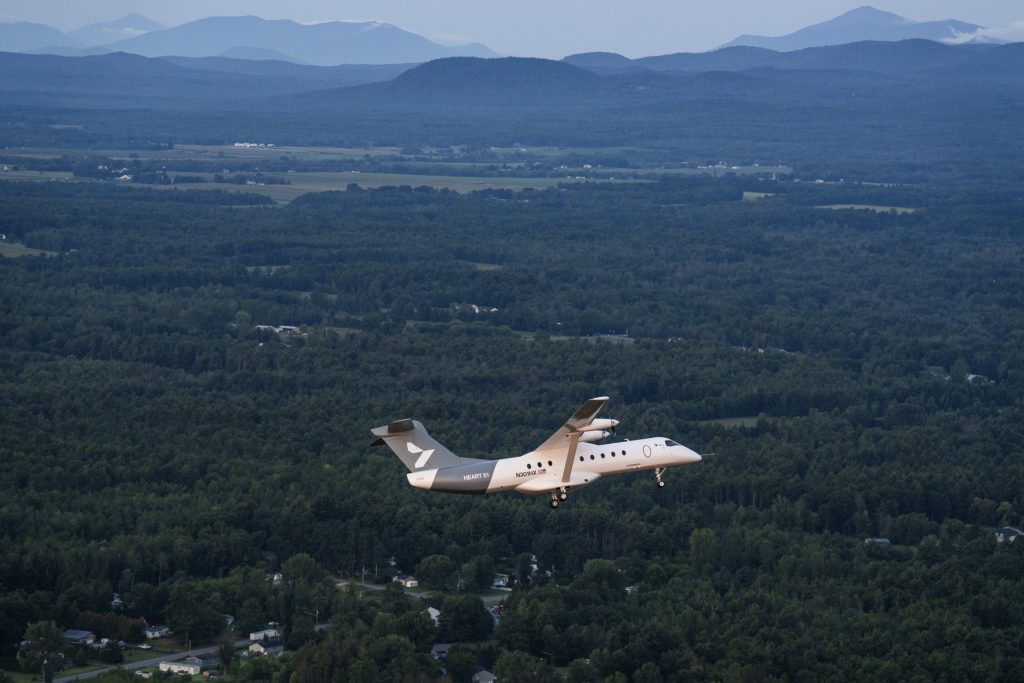
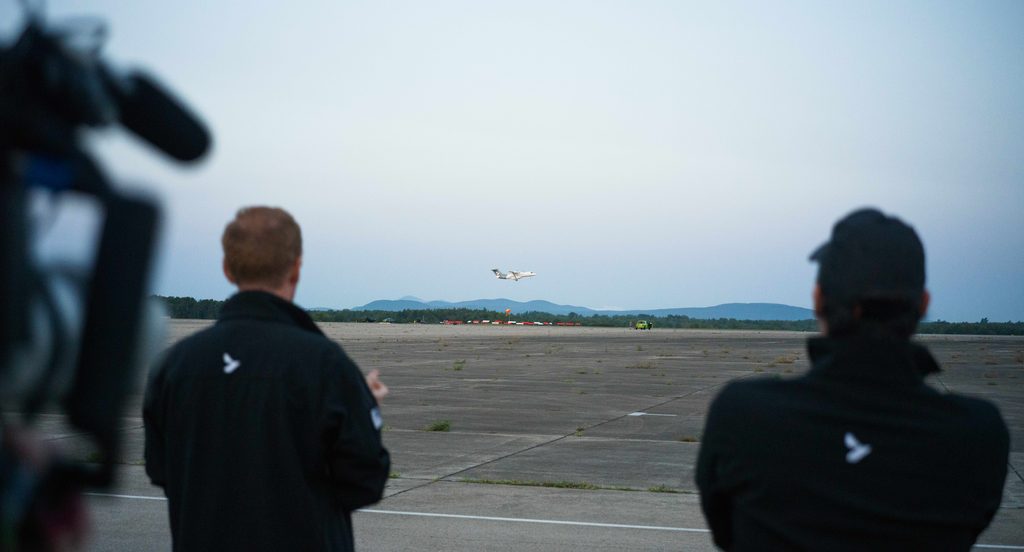
Yesterday, 25,000 pounds of carbon fiber, batteries, and one brave pilot flew without burning a drop of jet fuel. X1, Heart Aerospace’s demonstration electric aircraft, departed from New York’s Plattsburgh International Airport just before 6:00 AM, climbed 1,100 feet in near silence, banked a loop, and landed 8 minutes later beneath a red sunrise. The largest electric battery plane to ever take flight cost Heart an electricity bill of $5.
Unlike every other major aerospace milestone, the X1’s electric buzz registered just a few meager decibels, easily drowned out by the celebratory hooting and hollering from those on the tarmac. The team had good reason to out-clamor a twelve-ton airplane. Gasoline has kept the aviation industry in a stranglehold since its conception. But battery chemistry and calloused engineering have finally breached this energy-dense beachhead. Now, a slew of companies are proving that electric batteries have the juice to lift heavy machinery off the ground. Most, including some that have already rung the bell, are targeting a 4-seater model. Heart just pulled up to the squadron with a 30-seat behemoth in tow.
A Better Rewards Program.
Heart’s next stop is the ES-30: a 30-seat, single-pilot regional aircraft carrying a propulsion system capable of going 125 miles fully electric and up to 500 miles hybrid. Maintenance costs are low because electric motors have fewer parts and therefore need less repair. Onboard software automates administrative tasks like ATC coordination and ground turnaround logistics. And every part is mass-manufacturable and interchangeable. The whole plane charges in just 30 minutes.
For noise-restricted airports like Aspen, the ES-30’s near-silent engines are a major plus. But most people care more about dollars than decibels. The ES-30 reduces aircraft operating cost by 40% compared to the ATR 42 and the CRJ 200, the workhorse models for US commuters. Those two were first flown in, get this, 1984 and 1991, respectively. Back when Pan Am still ruled the skies.
You see, just about the only data point in the airline industry that’s falling is the number of flights traveling less than 250 miles. In the past decade, they’ve fallen by 11%, the greatest drop of any route length. You simply can’t run a profitable 200-mile beat on airframes designed when gas was a dollar a gallon. The ES-30 resets the cost basis. Cheaper flights make these routes viable again, and a map of American aviation that’s been shrinking for a few decades starts growing again.
The major carriers hoping to avoid the fate of Spirit Airlines are all too eager to dispense with the jet fuel headache. Going electric saves these airlines money, opens new markets, and eases some of their public image problems too. Aviation has contributed 2.5% to global CO2 emissions, but up to 4% of atmospheric warming. Once burned, jet fuel releases other gases like NOX, water vapor, and sulfur aerosols that impact the chemical composition of the troposphere. If you want to understand just how dangerous that pollution is, a brief primer appears on pages 1 through 3,949 of the latest IPCC report.
Then again, the airline industry has never been in the business of saving the world. It’s barely in the business of saving itself.

The Flight of the Concordes.
Unless you design reusable rockets or drones, the aluminum-tube business has remained surprisingly stagnant as of late. The newest commercial airplane, the Airbus A350, is already a decade old. Lockheed Martin’s F-35 Lightning II, the canonical fighter jet of the U.S. Air Force, took its inaugural flight in 2006. That’s not to say upgrades haven’t happened. They’re just hard to see, confined to incremental advances in lighter materials, digital flight decks, and (somewhat) workable WiFi. Those gains do little to offset the trends customers actually notice: higher ticket prices and ever smaller soda cans.
Major leaps in aeronautics are brutally hard to pull off. Even among companies making things in the Real World, flying machines are orders of magnitude more complex than anything firmly at peace with gravity. The inflection points in hard tech happen when the stakes are highest. It’s why milestones like X1’s inaugural flight are celebrated with champagne and teary-eyed hugs instead of Slack emojis.
Disruption is risky when breaking things can mean a plane crash. Only a handful of companies are trusted to make the world’s half a million aircraft. Compare that to the hundreds of car manufacturers that produce nearly 2 billion automobiles. Real innovation requires many cheap shots on goal, which aviation’s unit economics can’t afford.
This holding pattern will continue so long as the industry’s margins remain razor thin. Building, repairing, and flying planes is expensive. It’s estimated that airlines only make the equivalent cost of a Big Mac ($7.90) per traveler. In 2025, U.S. airline companies raked in a paltry profit of $6 billion from a total operating revenue of $252.6 billion. For an industry that moves over a billion passengers a year, the whole business nets just a little more than Domino’s makes selling pizza.
It may feel like Delta is robbing you of your wallet, shoes, and dignity every time you board a Boeing, but they’re really just covering the costs of the ridiculous number of logistical steps involved in transporting living cargo. Overall, airlines actually lose money moving people and are forced to recoup the cost through ancillary income streams like credit card rewards. You’d be forgiven for asking how any of this flies.
A company attempting to retool this industry for the electric era will need to drastically reduce the cost of simply operating the machine. In aviation, that means going after the one part of the design that still works by blowing things up: the engine and the fuel that feeds it.

Kill the Fuel, Fix the Economics, and Save the Ozone While You’re Up There.
About a third of a commercial aircraft’s weight is oil. Much of it is there for the sole purpose of lifting the rest of itself off the ground. It is one of the most expensive liquids on the market, and its price swings wildly depending on the daily temperaments of select world leaders. Welcome to the wonderful world of jet fuel.
Jet fuel is a higher-density type of gasoline designed to handle the demands of an airplane turbine. Yet, like its vehicular counterpart, it is dependent on the same delicate web of extractive and fragile supply chains. Even the U.S., which produces the largest share of global jet fuel by a wide margin, is not immune to geopolitical shocks. Popular domestic flights in America this summer are 35% more expensive than last year. Delta even has its own oil refinery in Trainer, Pennsylvania, to buffer against shocks like these (tough luck to those without the privilege to get high on their own supply). Globally, it’s estimated that the airline industry will spend an additional $100 billion on jet fuel in 2026 due to closures in the Strait of Hormuz.
Heart’s liftoff offers an escape hatch from this petro-racket. Flooding a kerosene-dominated market with cheaper and quieter electric turboprops changes the economics of air travel, reinvigorating the declining regional airline industry while opening new locations on the map for business. Once established, those routes will become the most cost-effective and fastest way to move a human plus 55 pounds of luggage across 500 miles. And this will all be done without pouring massive amounts of heat-trapping gases into the upper atmosphere.
No one wants alternatives to jet fuel more than the airline industry itself. Kerosene consumes nearly a third of their operating budget at a price that has never known a stable day. So it’s no surprise that Heart already has billions of dollars worth of orders from the likes of United, Air Canada, and other major international and regional airlines. All of whom are rooting for Heart nearly as hard as the team is.
Heavy Machinery Runs Even Better on Electrons.
On his 3 AM drive over to the hangar before X1’s flight, Anders Forslund, co-founder and CEO of Heart, saw a shooting star. It doesn’t take much imagination to guess what he wished for, but omens are for people who don’t have a cross-continental crew building a first-of-its-kind, 30-seat electric airplane, finished in a year while navigating the justifiably labyrinthine regulations imposed by the Federal Aviation Administration. Anders has that and more.
We invested in Heart when it was just Anders and a few sketches. Now, he’s backed by an engineering division hailing from the likes of SpaceX and Rolls-Royce, and battery wizards from Tesla, Virgin Galactic, and Relativity Space. These are the folks who enjoy working on hardware that transforms our relationship to space and time. They’re now at Heart, adding a 106-foot wingspan to the electric revolution.
The era of strapping ourselves inside a burning fuselage is coming to a close. Feel that electricity in the air? You can now ride it.