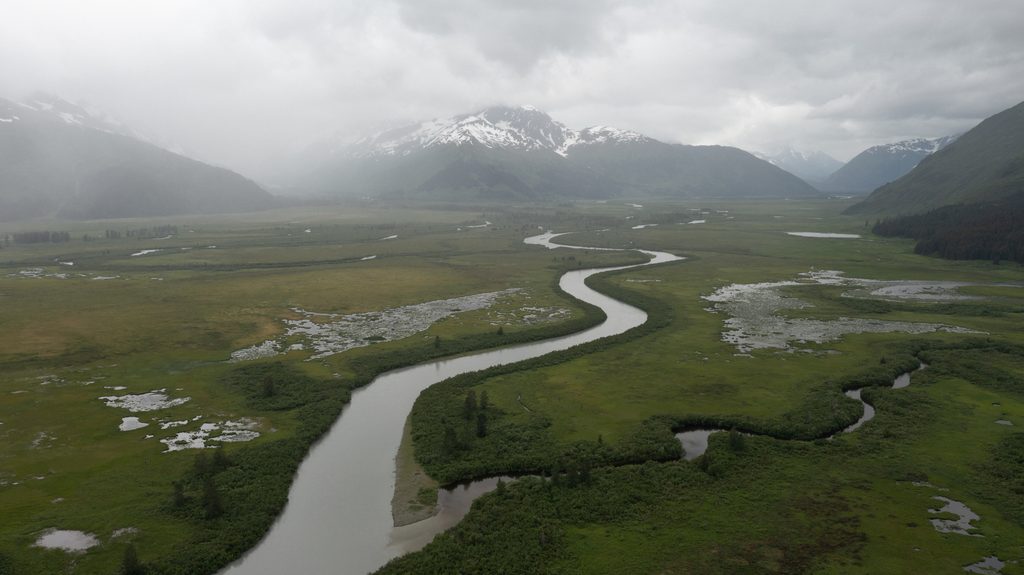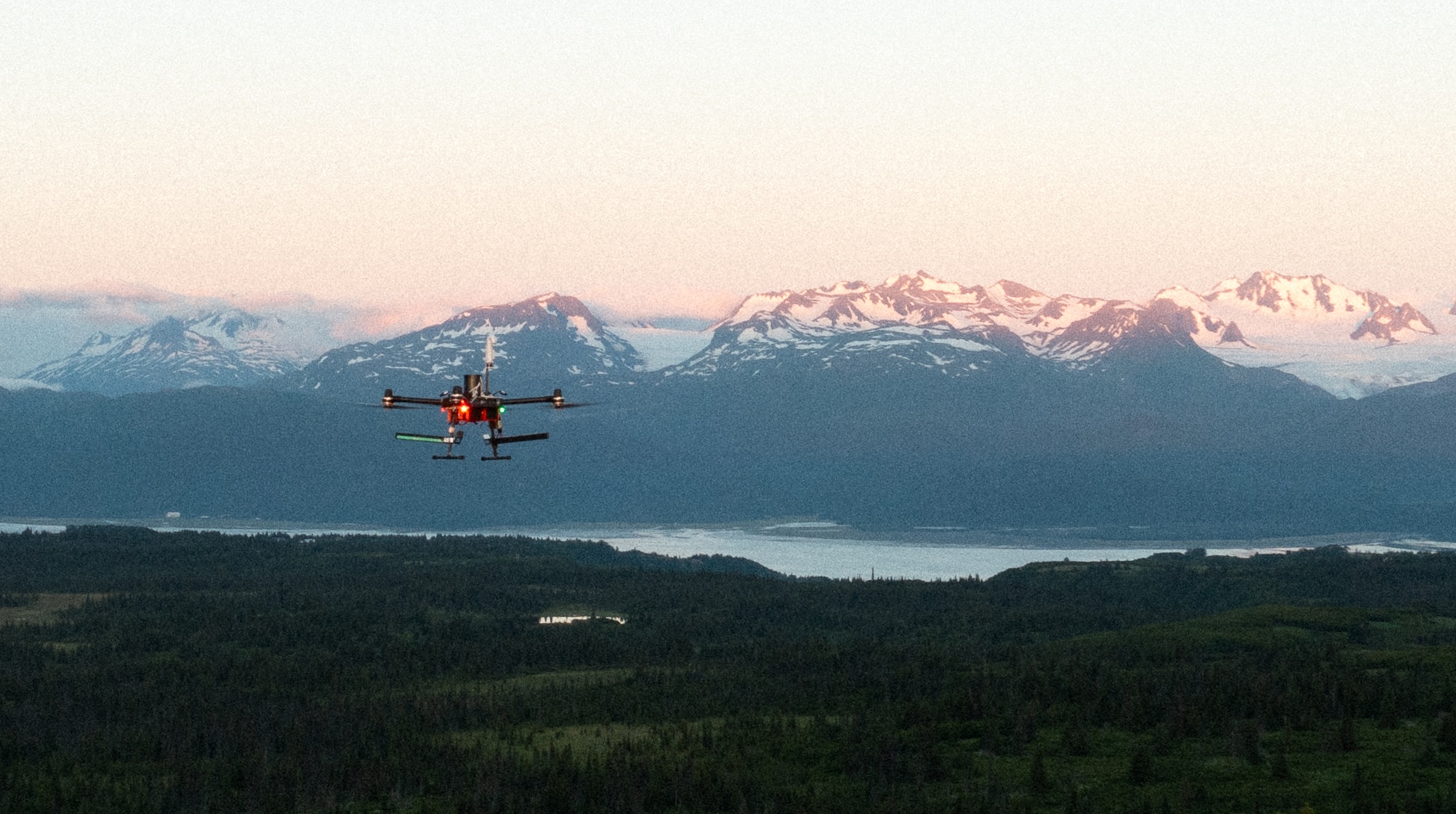
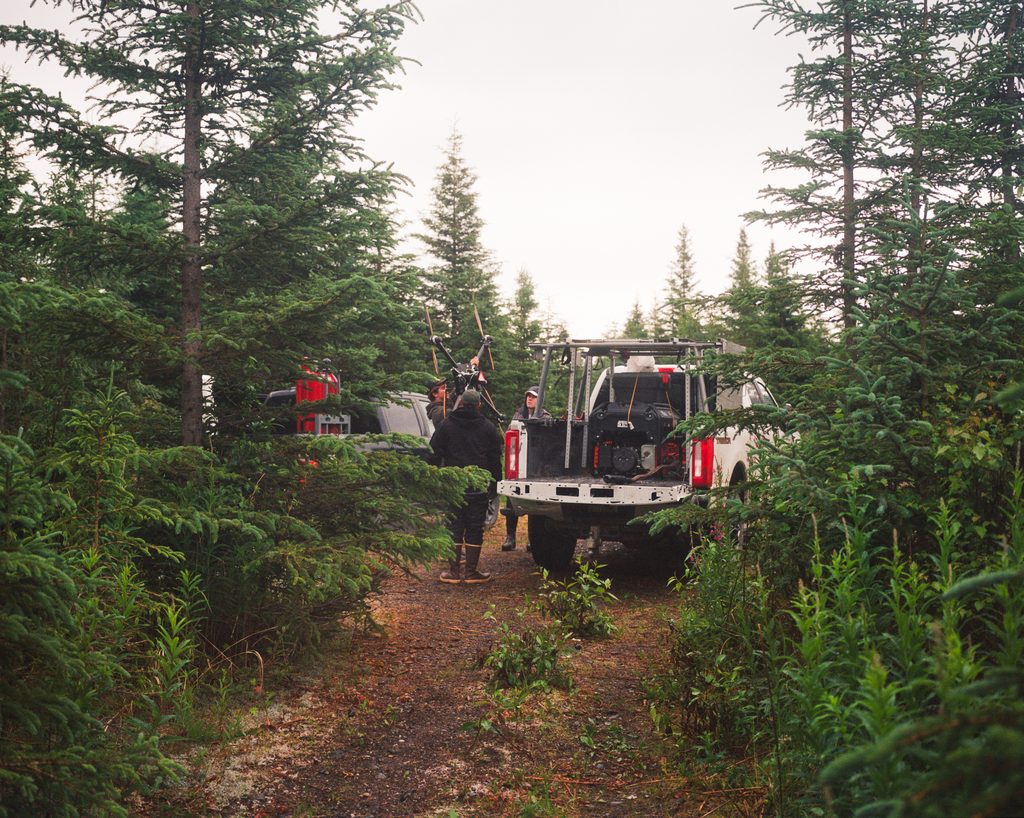
An 11 p.m. sunset glances off melting glaciers on Alaska’s Kenai Peninsula, and two moose hunters are chatting with a handful of tech guys from the Lower 48. The hunters had driven over on their gun-mounted ATVs with the unbothered air of men accustomed to battling megafauna. They were eager to learn more about Rainmaker’s outfitted Ford F-150s and flying contraptions they’d spotted roaming around their remote peninsula. Gus, the program manager of Kenai Research Division, answers questions as he gives a tour of the 55-pound quadcopters named Elijah lying on the mud at their feet. In just a few weeks, it would take drones like these just 3 hours to generate 19 million gallons of freshwater with less than a pound of silver iodide.
A great deal has been written about Augustus Doricko, Rainmaker’s founder and CEO, and his merry band of cloud wranglers. In the early days, articles struggled to get through the lede without mention of American flag-clad El Segundo offices, tins of Zyn, and Augustus’ exceptional mullet. Guilty as charged. But what they’re now starting to grasp is that, without upstarts like Rainmaker, we are consigning ourselves to a future of water scarcity, mass migration, and worse.
That is the drive behind Rainmaker’s $100m Series B, announced today. We backed it for the same reason we led the A: drought is not a problem we can solve through rationing or conservation.
Water Infrastructure Without the Infrastructure.
To take a holistic look at the state of freshwater today is to witness a rapidly diminishing resource propped up by a truly stupendous amount of concrete. Just 23% of Earth’s rivers flow to the ocean unimpeded, their dams feeding reservoirs and irrigation systems that turned vast arid tracts of the planet into habitable land. That the Western United States is populated at its current scale is thanks to engineering projects of historic proportion, passages of federal acts with so much governmental overreach that some consider them socialist, and several generations of taxpayer money.
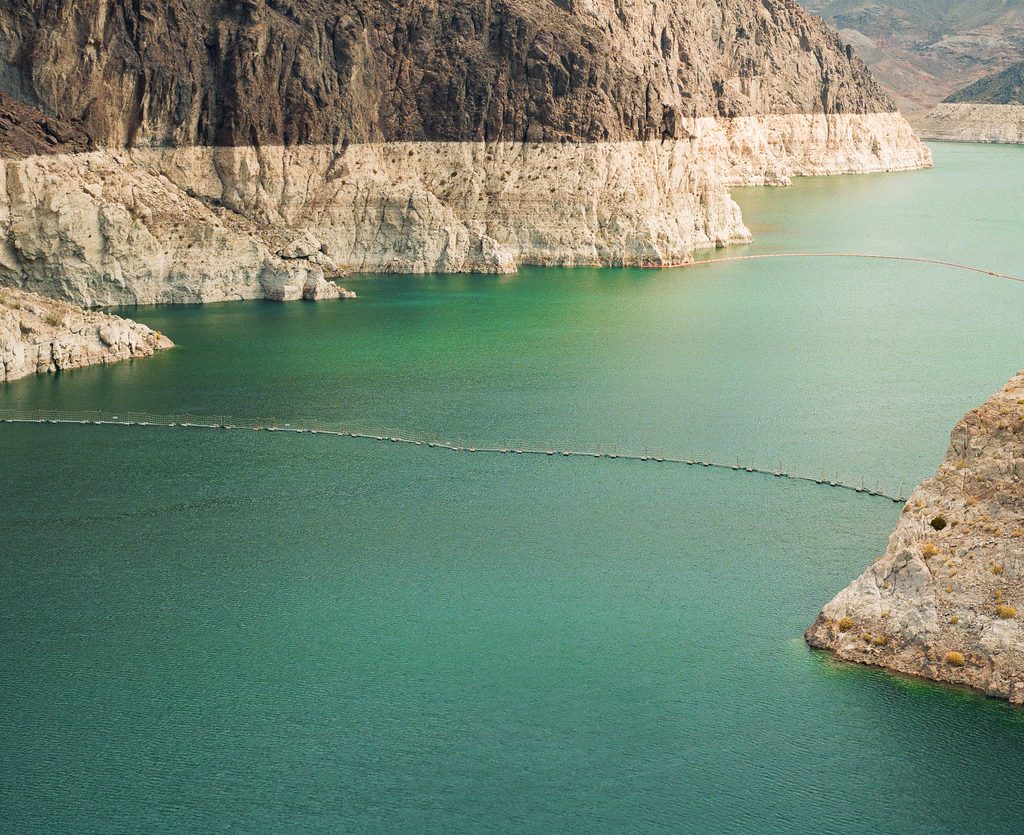
That inheritance has historically made water look deceptively cheap, even as the West fought bitterly over who got it, who paid for it, and who went without. Now, drought is pushing that old bargain, the Colorado River Compact, to a breaking point as it moves through the United States at a blitzkrieg pace. Scientists just warned that one more dry year could crash the entire Colorado River basin system, an area that supplies water to 40 million Americans and 5 million acres of farmland. Glen Canyon and Hoover Dam are operating at a third of their nameplate hydroelectric capacity due to reservoir levels reaching record lows.
After years of negotiation over how to save the Colorado River, the answer from Washington arrived this summer: take less of it. The U.S. Bureau of Reclamation decreed that California, Arizona, and Nevada must reduce water consumption by 1.25 million acre-feet per year, enough to cover all of Los Angeles County in nearly six inches of water.
Answers like these are no longer sufficient when some $58 trillion of global economic value is on the line (though history suggests that there is no price limit on civilizational necessities). The goal of Rainmaker’s current campaign is to add roughly 8 million acre-feet of water a year to the Colorado River, doubling its current flow, by 2031. Desalination, one of the only other proven technologies to generate new freshwater, costs thousands of dollars an acre-foot, and that’s before anyone builds the pipes required to push it hundreds of miles inland and uphill.
Augustus’ closer objective this rain-making season is to generate more freshwater than the desalination plant in Carlsbad, California (~ 56,000 acre-feet) at a tenth of the cost. With one eye on the rising price of electricity and the other on Rainmaker’s recent results in Alaska, our money is on the water plant that fits in the bed of a truck.
How to Make It Rain.
In Alaska in the summer of 2026, a dozen or so Rainmakers live in a lodge that’s part home, part workshop, abiding by a lifestyle somewhere between an oil rig worker and a storm chaser. The front lawn is a makeshift airstrip for the occasional bush plane. In the backyard, two crows battle a bald eagle above a weather radar unit. Various items are spinning, charging, and glowing in the garage. The sounds of French rap and the hum of 3D printers emanate from the basement.
The best conditions for making rain occur in winter. In the off-season, as it is now in the Northern Hemisphere, the Rainmakers conduct research to validate their commercial operations. Besides 18 hours of premium summer sunshine, Kenai is one of the few places in America that offer favorable meteorological conditions during the summer for supercooled water, a term the engineers murmur with a sort of reverence.
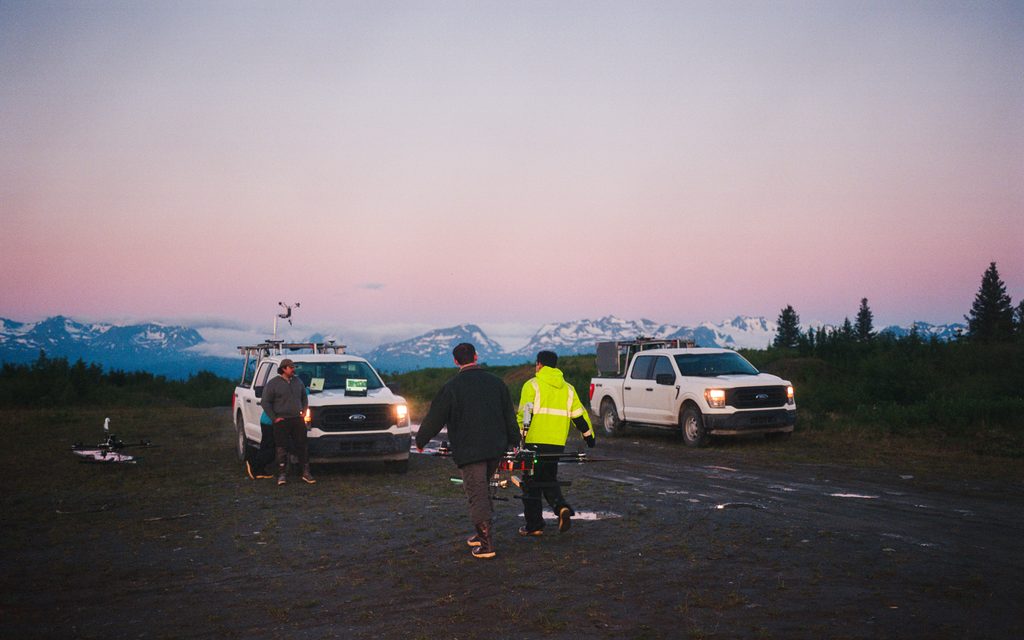
Once supercooled conditions are spotted on the radar, the Kenai Research Division launches from their pre-approved sites across the peninsula. One is on a boggy glacial deposit owned by the Ninilchik Traditional Council, where Rainmaker has a meteorology day planned for the community to walk them through what’s happening overhead. Another is located on land managed by the Alaska Department of Resources, a majestic, bullet-littered landscape if there ever was one. Operations begin with little ceremony. The trucks are loaded, and the equipment is prepared. A senior Rainmaker says to a recent hire, “You ready, weather boy?” And they’re off.
The Kenai Research Division organizes into strike teams named Moose 1 and Moose 2. Each Ford F-150 is outfitted for rapid deployment, allowing a single Rainmaker to unload and launch a drone in under 7 minutes. Vehicles are equipped with fire extinguishers, portable generators, Starlink, and bear spray. A shotgun is secured nearby in case a drone falls deep in the woods where the grizzlies roam.
Once in position, the drone is prepared like a pit crew in reverse, with Rainmakers stripping the car of various items to reassemble on the ground. A few minutes later, the drone whirs up to 14,000 feet above sea level. Its carbon-fiber blades resist the freezing temperatures, but Elijah carries a parachute that will automatically deploy should something go wrong. Under its chassis hangs a flare afire to precisely disperse particles of silver iodide into the clouds.
Fifty Years of Doubt Answered in Forty Minutes.
Many clouds contain supercooled water, or droplets that remain liquid despite freezing temperatures because they have nothing to freeze onto. Introduce an impurity—a grain of dust or a particle of smoke—and ice crystals form around it, grow heavy, and fall as snow or rain.
That is more or less how clouds have formed and fallen for the past few billion years, until, in 1946, a scientist at General Electric generated rain in a box with dry ice. The decades that followed Vincent Schaefer’s cloud-seeding discovery are an utterly fascinating chapter of the U.S. government’s foray into weather modification involving hurricane steering, questionable military exercises, and the Vonnegut brothers, Bernard and Kurt.
And yet, despite containing all the right ingredients for a massive industry, a deluge of failures blocked serious progress. By 1975, after more than a decade of federal experimentation, a government review diagnosed the crux of its failure: “Current evaluation methods are not adequate to distinguish natural from man-made changes.” Though not usually one to shy away from expensive battles with thermodynamics, Washington was unwilling to keep footing the bill for science that could not vouch for its own results.
That is not an ambiguity Augustus is willing to tolerate, especially when answering to the one group more intimidating than Congress: shareholders. Rainmaker must prove that its cheap, custom-made drones can deliver rain down to the acre. To do that, it has built Stratus, an all-in-one AI-powered command center. Stratus identifies the right meteorological windows days in advance by ingesting more than 20 streams of real-time weather data to forecast viable seeding conditions. Once an Elijah is airborne, Stratus charts its path and records flight data. The program then triangulates all these data points to look for evidence of rain within a downwind corridor.
In Rainmaker’s September 23rd operation in Alaska, seven such seeding signatures emerged between 17 and 40 minutes after the silver iodide was released, some hanging around for more than an hour and spreading across dozens of square kilometers. Even then, Rainmaker doesn’t claim every drop inside them as its own. Stratus estimates the natural rain already falling through the area, subtracts that background from the radar signal, and runs what remains through an ensemble of precipitation models. Within those radar pixels, the sweet sight of bona fide human-made rain.

The Overton Window Is Shifting. Don’t Be Left Behind.
A popular misunderstanding is that Rainmaker makes clouds. They don’t. Rainmaker increases the amount of precipitation that falls from clouds already passing overhead by a few percentage points. It’s more like encouraging growth by adding compost to your soil. Only a fraction of the water in any weather system ever falls to the ground. As Elijah travels along its pre-set flight path, silver iodide gives supercooled droplets something to latch onto, forming ice crystals that grow heavy and fall. In effect, it squeezes a little more water from the clouds.
The conspiracy age turned “cloud-seeding” into a loaded term, severing its scientific reality from popular perception. As such, Rainmakers educate and engage with the public wherever they currently stand, whether that be on marble in loafers or on a glacial bog in muck boots. Many of them start skeptical, leave curious, and call back when the rain doesn’t. Extreme weather has a way of making radical ideas look overdue.
The scenes playing out in Kenai are a preview for what’s to come. Though based in El Segundo, California, Rainmaker’s operational hub is on the shore of the Great Salt Lake, a body of water that has lost 64% of its volume since the 1980s. It is from this node that Rainmaker sets forth across the great American West in their trademark trucks and jovial demeanor. They currently operate across five states and hire at least half of every field team from the local community. There’s a guy like Gus for each region whose job is to know the terrain, locate the favored local water hole (the kind Rainmaker can’t refill), and get the Elijahs into the sky right when the clouds arrive.
Rainmaker is well into building a water stewardship program that is distinctly American: a bottom-up, profit-seeking enterprise run by men and women with varying political and spiritual beliefs, all united by a fervent desire to produce more water, something that human civilization simply cannot do without. They are open about their research, publishing validation reports for anyone to scrutinize (though it helps to know what terms like ‘ceilometer backscatter’ mean).
Utah and Idaho have committed millions to an interstate program in the Bear River Basin, where Rainmaker is deploying a fleet of 32 drones to increase snowpack and ultimately replenish the Great Salt Lake. Across Utah, water districts have signed their own contracts. In West Texas, local water boards have done the same. Colorado, Oregon, and California municipalities have hired them too. The executive director of Utah’s Division of Natural Resources called their partnership with Rainmaker “the smartest thing we can be doing with our money.”
These states are the first movers in America, but are still late to the game globally. China has assembled a weather modification program funded by billions of dollars to generate rainfall across half its gargantuan territory. Photos of Chinese rain-makers look nearly indistinguishable from military operations, with helmeted soldiers loading silver iodide shells into retrofitted anti-aircraft artillery. The country that anticipated the booms in electrification, minerals, and advanced manufacturing is treating water the same way, as a strategic resource worth securing before everyone else realizes how scarce it has become.
China is hardly alone. Some fifty countries now run cloud-seeding programs to bolster their water resources, some of which are partnering with Rainmaker. The question is no longer whether humans will make more rain, but who will get good at doing it first.
Hold the Line.
The Rainmaker team and the moose hunters would continue bumping into each other out on the glacial peninsula thick with mosquitoes. They developed a routine: the hunters would joke about making rain in a place as wet as Alaska; the Rainmakers would catch them up on the latest they’d learned.
These lessons were far from academic. A few thousand miles away in the continental US, fire season was in full rage. Cameron, one of Rainmaker’s in-house meteorologists, mentions that a wildfire is burning mere hours from his parents’ home in central Oregon. At the time, 88% of the state was experiencing drought, and the fires would go on to scorch 2.5 million acres.
Cameron holds a white balloon, now enormous with helium, attaches a radiosonde to the bottom, and releases it right before an Elijah takes off. The balloon catches wind and begins its rapid ascent through the same atmosphere the Rainmakers shape with increasing success.
If the past century was defined by the blind transformation of Earth’s physical systems, then surviving the next one hinges on learning to more precisely steward them. The atmospheric rivers that provide up to half of the West’s annual precipitation thrash across the continent like an unattended firehose. Rainmaker is making a wager that, at last, we might reach for the nozzle.
Come winter, Rainmaker’s drones will follow that weather south, pollinating the clouds like bees and padding the Rockies with sweet powder. Some of it will melt in the spring, cascading down through rivulets into the vein-like waterways that bring life throughout the West. By July, those gallons will accumulate among the 20th century’s cathedrals of cement, irrigating soil and running through taps. Every river begins as weather. Keeping the Colorado alive begins before the headwaters.