

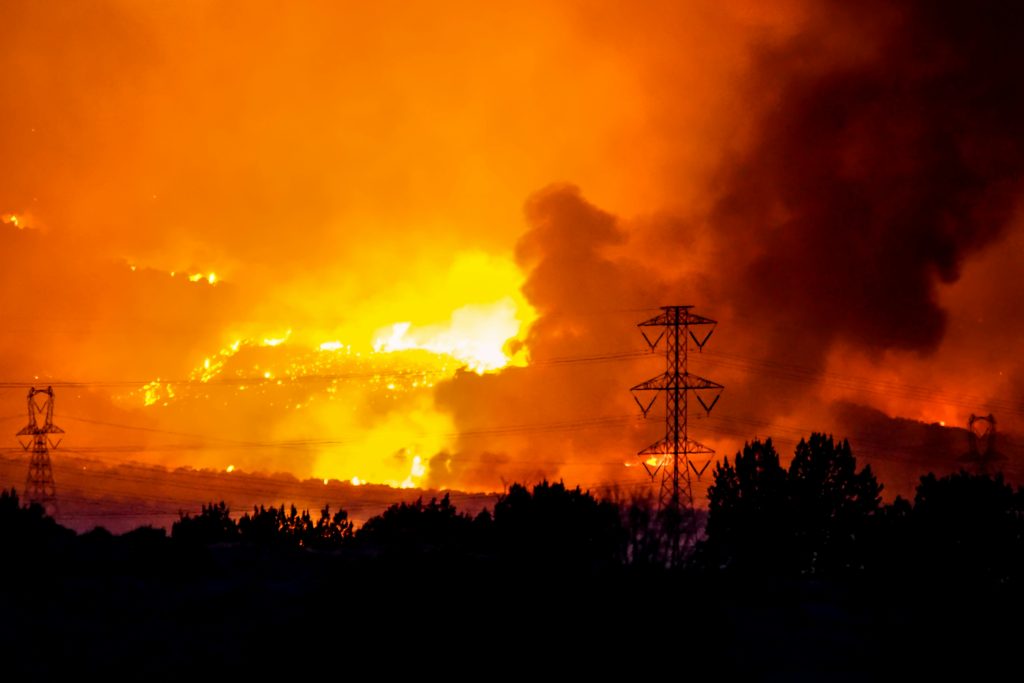
A wildfire races toward a cedar-shingled home on a California hillside, burning through dry brush and spewing embers onto its roof. Moments later, a magnitude 6.0 earthquake rocks its foundations. Just as the tremors subside, a once-in-a-century flood sweeps through whatever is left. Then a mouse cursor moves across the wreckage. The simulation is complete. Within a few seconds, a Stand technician has an insurance quote for a home the major carriers had abandoned, and a list of ways to better protect a family’s most valuable asset.
When we co-led Stand Insurance’s Series A in 2024, the core bet was that rising entropy in the Earth system, chronic underinvestment in resilience, and decades of insurance industry leaders sticking their heads in the sand had broken the home insurance industry. Incumbent carriers relied on outdated weather history to price houses by ZIP code, unable to distinguish a fireproofed home from a tinderbox next door. Misguided policies intended to protect consumers had the opposite effect. Unable to price risk, insurers jacked up premiums or abandoned neighborhoods and even states wholesale.
Stand’s founders, Dan Preston, who took the auto-insurance company Metromile public, and Jason Mueller, formerly of Policygenius, knew the industry well enough to recognize the enormous opportunity in its retreat. They wanted to create an insurer that could model the physical risks of individual homes, then reward owners for making them safer.
Now, two years and a remarkable amount of computational wizardry later, Stand has raised a $70 million Series C at a $1 billion valuation to make sure our homes and communities still stand after natural disasters strike.
Your Home’s Digital Stunt Double.
To live inside Stand’s World Model is to preview an unenviable future. That’s the point. It is better to discover all the ways your house might burn, buckle, or flood inside a computer, where the damage can be undone with a click, than wait for nature to conduct its own experiments.
Stand recreates each customer’s property as a detailed 3D digital twin, then simulates how fire and wind move through its surroundings. Everything from the roofline to the species of trees in the front yard can influence the outcome. And Stand can model what happens when the homeowner changes those details.
Remove a flammable hedge, replace some vulnerable vents, or clear the brush around your house, and Stand can calculate how much safer the property becomes. The resulting reduction in risk translates into lower premiums. For the first time, a homeowner can take a pruning saw to their insurance bill.
With Stand’s model, their California policyholders have now renewed well above the industry norm. Losses have been near zero during its first year and a half of underwriting. And the reinsurers who put their own money behind Stand’s policies have extended more capacity on better terms. The business is outpacing the bull case we laid out in our first investment memo.
Meanwhile, Stand’s engineers have stripped out a spectacular amount of GPU-hours from the underwriting process. Their original computational fluid dynamics simulations took up to a half-day to evaluate a single house. Then they built Inferno, an AI model trained on thousands of those painstaking simulations. The platform can now estimate a home’s risk in a few seconds for around fourteen cents a pop, reproducing the original engine’s risk-ranking accuracy.
Beyond the Burn Zone.
California was the obvious place to start, where worsening wildfire seasons had collided with a home insurance market in disarray. But the Golden State doesn’t have a monopoly on weather-related insurance misery.
In June, Stand opened for business in Florida, where homeowners have spent years watching hurricanes tear through their properties and insurance premiums. Out in the Sunshine State, the threat is more likely to arrive as a hundred-mile-an-hour gust than a flying ember. But the underlying business proposition travels well: model the damage before it happens, show homeowners how to prevent it, and charge for the risk that remains.
Now that Stand has built a playbook for expanding into new geographies and perils, expect them to run it. They’re gearing up to open in a handful of states in the coming months, with an ambition to expand beyond homes to commercial properties facing a range of hazards. While wildfires consumed a lot of the disaster-related headlines over the last year, hurricanes and severe storms represent a market several times larger than wildfire insurance alone.
Yet, swapping out one insurance policy for another is not the end objective. There are trillions of dollars worth of assets at risk in the US alone, and tens of trillions more around the world. Leaving them exposed risks toppling the global economy. Stand’s mission is to bring those numbers down.
Most people think of insurance as the check that arrives after the roof blows away because – after hours waiting on hold with agents, countless moments lost compiling invoices, and sleepless nights in hotels wondering if you’ll ever go home – that’s how insurance works today. Stand would rather help you keep it attached. By giving property owners a financial incentive to reinforce their homes before disaster strikes, the company intends to spur billions of dollars in resilience upgrades while making coverage cheaper and more available.
Insurance has always been good at putting a price on disaster. It’s about time someone figured out how to make money preventing the damage.